

Table of Contents
- How to Choose the Right Pillow: Key Factors That Matter
- Step 1: Identify Your Sleep Position and Loft Needs
- Best Pillow for Side Sleepers: Materials and Support
- Pillow Materials Explained: Memory Foam, Down, Latex, and More
- Pillows for Neck Pain: Cervical Alignment and Ergonomic Design
- Step 2: Match Your Pillow to Your Mattress and Sleep Surface
- Step 3: Consider Firmness, Size, and Temperature Regulation
- When to Replace Your Pillow: Longevity and Hygiene Science
How to Choose the Right Pillow: A 2026 Guide
Last Updated: July 25, 2026
Learning how to choose the right pillow is one of the most overlooked decisions affecting your sleep quality. This single item influences your spinal alignment, neck pain levels, and overall rest for 6-8 hours every night. At Smart Buy Shop, we've analyzed the key factors that separate a pillow that transforms your sleep from one that leaves you waking with neck stiffness. Below, we'll walk you through a practical framework that accounts for your sleep position, mattress compatibility, materials, and budget.
Why Pillow Selection Impacts Sleep Quality
Your pillow's job is to support your head and neck so your spine stays in a neutral position throughout the night. When a pillow fails at this, your neck muscles work overtime to compensate, fragmenting your sleep and contributing to chronic neck pain.
People using properly fitted pillows report falling asleep faster, experiencing fewer nighttime awakenings, and waking with significantly less neck discomfort. Temperature regulation also matters, your pillow sits inches from your face and ears, two areas that generate substantial heat. A pillow that traps heat will cause you to toss and turn throughout the night, fragmenting your sleep even if the loft and firmness are perfect.
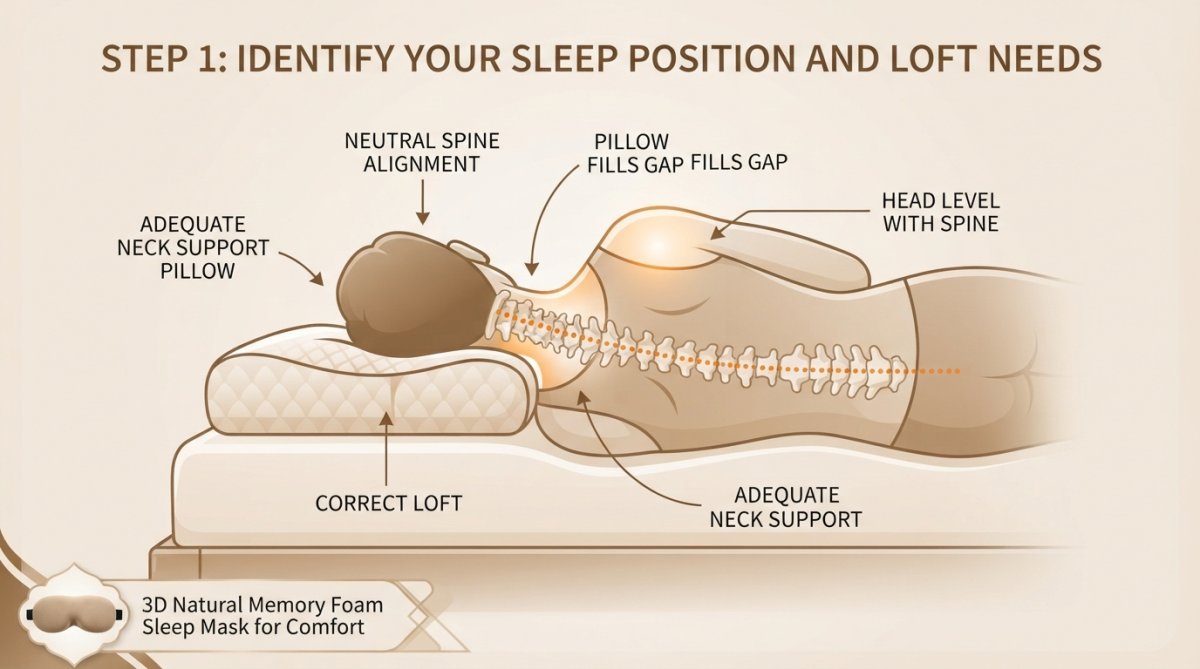
Step 1: Identify Your Sleep Position and Loft Needs
Your dominant sleep position determines the loft, or height, of pillow you need. Loft is measured in inches, typically ranging from 3 inches (very low) to 7+ inches (very high). The wrong loft creates misalignment.
Back Sleepers: Medium Loft for Neutral Spine
Back sleepers need a medium loft pillow, typically between 4-5 inches. Your chin should be parallel to the ceiling, not tilted up or down. A pillow that's too high will push your chin toward your chest, creating tension in your anterior neck muscles. Too low and your head drops back, hyperextending your cervical spine.
Back sleepers often benefit from pillows with a slight contour or cervical support ridge built into the design, which helps maintain alignment without requiring you to think about positioning.
Side Sleepers: Higher Loft for Shoulder Support
Side sleepers need the highest loft of any position, typically 5-7 inches. When you sleep on your side, your shoulder takes up vertical space. Without enough pillow height, your head drops toward your shoulder, creating a sideways angle in your cervical spine, one of the most common causes of side-sleeper neck pain.
The pillow needs to bridge the gap between your ear and the mattress. A good test is to lie on your side and check if your spine forms a straight line from your head to your hips. Side sleepers should also pay attention to pillow width to ensure their shoulder can rest partially on the pillow, distributing pressure more evenly.
Stomach Sleepers: Lower Loft to Prevent Neck Strain
Stomach sleeping is the most challenging position for spinal alignment. Stomach sleepers should use the lowest loft available, often 2-4 inches, or even no pillow at all under the head. When you sleep on your stomach, your head is already rotated 90 degrees to one side. Adding height to the pillow increases the rotation and puts additional stress on your cervical spine.
Many stomach sleepers benefit from placing a pillow under their pelvis instead of (or in addition to) their head, which reduces the arch in your lower back.
Best Pillow for Side Sleepers: Materials and Support
Side sleepers require consistent support throughout the night without excessive sinking. Memory foam excels for side sleepers because it conforms to your head and neck shape while maintaining enough structure to prevent over-sinking. A medium-to-firm memory foam pillow (around 5-6 inches loft) gives side sleepers the support they need.
Latex pillows also work well for side sleepers who want a firmer, more responsive feel. Down alternative pillows can work for side sleepers if they're densely filled, providing both comfort and the structure side sleepers need.
Pillow Materials Explained: Memory Foam, Down, Latex, and More
Your pillow's filling material determines how it feels, how long it lasts, how it regulates temperature, and whether it triggers allergies.
Memory Foam: Pressure Relief and Contouring
Memory foam pillows conform closely to your head and neck, distributing pressure evenly across the contact surface. This contouring action is why memory foam excels for people with neck pain. The density of memory foam matters significantly, high-density memory foam (5+ pounds per cubic foot) holds its shape longer and provides more support. Memory foam pillows typically last 2-3 years before they begin to compress permanently and lose support.
For hot sleepers, memory foam can feel like it's trapping heat since it responds to body heat and softens as it warms up.
Down and Down Alternative: Natural Comfort and Hypoallergenic Options
Down is exceptionally comfortable and naturally breathable, but compresses significantly over time and may not provide adequate support for side sleepers or people with neck pain. Down pillows can also accumulate dust mites and their droppings, which trigger allergies in many people.
Down alternative pillows use synthetic fibers designed to mimic down's softness while offering hypoallergenic properties. A quality down alternative pillow can feel nearly identical to real down while being machine-washable and resistant to dust mites.
Latex: Durability and Cooling Properties
Latex pillows offer exceptional durability, maintaining their shape and support for 5-7 years or longer. Latex is naturally hypoallergenic and resistant to dust mites, making it an excellent choice for people with allergies. Latex is also highly breathable and doesn't trap heat the way memory foam does, making it ideal for hot sleepers. The downside is that latex can feel less contouring than memory foam and tends to be more expensive.
Polyester Fill: Budget-Friendly Firmness
Polyester fill pillows are the most affordable option but compress quickly and don't maintain their shape well over time. These pillows are appropriate for occasional use or extremely tight budgets, but not ideal for nightly use if you're dealing with neck pain.
Pillows for Neck Pain: Cervical Alignment and Ergonomic Design
Neck pain is often the result of poor cervical alignment during sleep. A pillow designed specifically for cervical support addresses this by providing targeted support under the neck while allowing your head to rest comfortably.
Cervical Support Technology and Neutral Spine Positioning
Cervical pillows feature a contoured design with a depression for your head and a raised ridge that supports the curve of your neck. This design keeps your cervical spine in a neutral position, aligned with your thoracic spine. The most effective cervical pillows have a ridge that matches the natural curve of your neck.
Cervical pillows work best for back sleepers and side sleepers. Stomach sleepers should avoid cervical pillows because the ridge will force your head into an unnatural position. Memory foam cervical pillows combine the contouring benefits of memory foam with the structural support of a cervical ridge, making them particularly effective for people transitioning from a flat pillow to cervical support.
Smart Buy Shop's Specialized Options
Smart Buy Shop offers targeted solutions for people dealing with neck discomfort. The [Cloud Ease Relax Neck Pillow](https://teayf3-f5.myshopify.com/products/relax-neck-pillow) at $49.99 combines ergonomic support with travel-friendly design. For those seeking active relief, the Neck & Shoulder Massage Pillow at $91.99 provides therapeutic benefits alongside structural support, addressing both alignment and muscle tension.
Step 2: Match Your Pillow to Your Mattress and Sleep Surface
Your mattress's firmness and sinkage directly influence which pillow will work best for you. This relationship is often overlooked, but it's critical for achieving proper alignment.
Understanding Mattress Sinkage and Pillow Compatibility
Mattress sinkage refers to how much your body compresses into the mattress when you lie on it. A soft mattress with high sinkage will cause your head to sink deeper into the bed. A firm mattress with minimal sinkage will keep your head higher.
If you have a soft mattress with significant sinkage, your head sinks lower than it would on a firm mattress. To maintain proper cervical alignment, you may need a lower-loft pillow to compensate. If you have a very firm mattress, you might need a higher-loft pillow because your head won't sink as much.
Before investing in a new pillow, honestly assess your mattress. If it's sagging significantly, sinking excessively, or more than 7-10 years old, replacing the mattress should be your first priority.
Pillow-to-Mattress Compatibility Matrix for Your Sleep Setup
Use this matrix to identify which pillow loft range works best for your specific combination of sleep position and mattress type:
| Sleep Position | Soft/High-Sinkage Mattress | Medium Mattress | Firm/Low-Sinkage Mattress |
|---|---|---|---|
| Back Sleeper | 3-4 inches | 4-5 inches | 5-6 inches |
| Side Sleeper | 4-5 inches | 5-6 inches | 6-7 inches |
| Stomach Sleeper | 1-2 inches | 2-3 inches | 3-4 inches |
If you're between two loft ranges, consider your neck pain history. If you've had neck issues, choose the higher loft to ensure adequate support.
Step 3: Consider Firmness, Size, and Temperature Regulation
Beyond loft, three additional factors determine whether a pillow will feel right: firmness, size, and temperature regulation.
Firmness Levels and Pressure Relief Balance
Pillow firmness is subjective, but there are general categories: soft (minimal resistance, maximum contouring), medium (balanced resistance and contouring), and firm (maximum resistance, minimal contouring).
Soft pillows feel luxurious but provide minimal support. Side sleepers generally need medium or firm pillows because soft pillows compress too much under the weight of your head. Medium firmness is the sweet spot for most people, providing enough support to maintain alignment while still feeling comfortable.
Standard vs. Queen vs. King: Pillow Dimensions Matter
Standard pillows (20" × 26") fit most bed frames and are appropriate for most sleepers. Queen pillows (20" × 30") provide an extra 4 inches of length. King pillows (20" × 36") are the largest standard size.
Side sleepers benefit from wider pillows because they can rest their shoulder partially on the pillow, distributing pressure more evenly.
Breathability and Cooling Technology for Hot Sleepers
If you wake up hot or sweat through your pillowcase, temperature regulation should be a top priority. Memory foam is the worst performer for temperature regulation because it traps warmth. Gel-infused memory foam is designed to dissipate heat better than standard memory foam. Latex and down pillows are naturally breathable and don't trap heat.
Pillow covers also affect temperature regulation. Covers made from cotton or linen breathe better than polyester.
When to Replace Your Pillow: Longevity and Hygiene Science
Most pillows should be replaced every 1-2 years, though this varies depending on material quality and maintenance. A pillow that's lost its shape or no longer provides support is doing more harm than good.
Signs Your Pillow Needs Replacing
Your pillow is ready for replacement if you wake up with neck pain or stiffness that wasn't present before, the pillow has permanent lumps or flat spots that don't fluff out, you can feel the pillow structure poking through the cover, or the pillow has absorbed stains or odors that won't wash out.
A simple test is the fold test. Fold your pillow in half. If it springs back to its original shape, it still has structural integrity. If it stays folded or springs back slowly, the fill has compressed and the pillow has lost support.
Pillow Maintenance and Dust Mite Prevention
Dust mites thrive in pillows because they feed on dead skin cells. Wash your pillowcase weekly in hot water (above 130°F) to kill dust mites. Wash the pillow itself every 3-6 months according to the manufacturer's instructions. Air your pillow in direct sunlight regularly, as sunlight naturally kills dust mites and helps dry out moisture that accumulates from sweat and humidity.
Use a pillow protector, a waterproof cover that sits between your pillow and pillowcase. Protectors prevent sweat, skin oils, and dust from penetrating the pillow itself, extending your pillow's lifespan by 6-12 months. If your bedroom is consistently above 60% humidity, use a dehumidifier to keep levels in the 40-50% range.
Choosing the right pillow isn't complicated once you understand the key variables: your sleep position, your mattress type, the material that suits your needs, and your budget. Smart Buy Shop's curated pillow options, including the Cloud Ease Relax Neck Pillow for ergonomic support and the [Neck & Shoulder Massage Pillow](https://teayf3-f5.myshopify.com/products/neck-shoulder-massage-pillow) for therapeutic relief, are designed to address the specific alignment and comfort challenges covered in this guide. Start by identifying your sleep position and mattress type, then select a pillow that matches those parameters. Your neck, and your sleep quality, will thank you.
Frequently Asked Questions
What type of pillow is best for side sleepers?
Side sleepers benefit most from pillows with higher loft (4-6 inches) that fill the gap between the shoulder and head, maintaining cervical alignment. Memory foam or latex pillows provide excellent support, while down alternative offers comfort without allergens. Look for firmness that prevents your head from sinking too deeply, which can strain your neck. The key is choosing a pillow that keeps your spine neutral throughout the night.
How often should you replace your pillow, and what are the signs?
Most pillows should be replaced every 1-2 years, depending on fill material and quality. Signs include permanent indentations that don't spring back, clumping, visible wear, or waking with neck pain despite proper sleeping position. Dust mites accumulate over time, affecting sleep hygiene and potentially triggering allergies. Regular pillow maintenance with washable covers extends longevity, but replacement becomes necessary when the pillow no longer provides adequate support for cervical alignment.
What pillow materials work best for neck pain relief?
Memory foam pillows excel at pressure relief and contouring to your head and neck shape, promoting cervical alignment. Latex offers similar support with better breathability and durability. For neck pain specifically, ergonomic or cervical pillows with contoured designs provide targeted support. Smart Buy Shop offers specialized options like the Neck & Shoulder Massage Pillow ($91.99), which combines support with therapeutic massage for targeted relief. Choose materials that balance firmness with comfort, too soft allows excessive sinking, while too firm creates pressure points.
Does mattress sinkage affect which pillow I should choose?
Yes, mattress sinkage significantly impacts pillow compatibility. A soft, high-sinkage mattress may require a lower-loft pillow to maintain neutral spine alignment, while firmer mattresses often pair better with higher-loft pillows. If your mattress causes your body to sink 2-3 inches, you'll need less pillow height to keep your head level with your spine. Consider your mattress type (memory foam, innerspring, hybrid) when selecting loft and firmness. This pillow-to-mattress compatibility ensures proper cervical support and sleep quality.
This article was written using GrandRanker


